
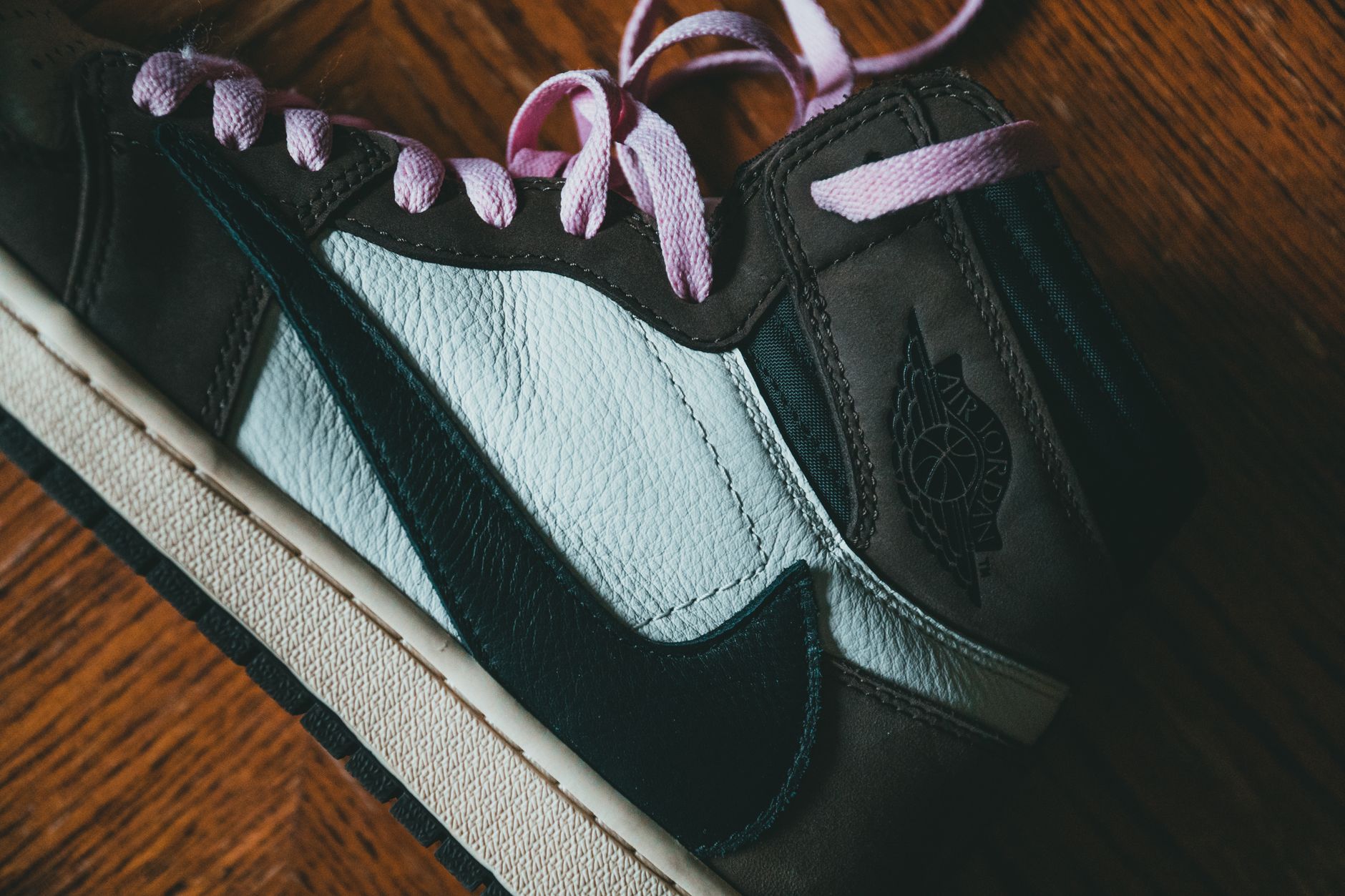
Legit checking Air Jordans used to be straightforward. A blurry swoosh or off-colorway box was enough to walk away. Today's replicas are closer to the real thing than most buyers realize, and the gap keeps narrowing. Still, every fake pair has flaws. You just need to know the right places to look.
This guide covers the most reliable checkpoints across the most commonly faked silhouettes: the Jordan 1, 3, 4, 11, and 12. The principles apply broadly to other retros too.
Start with the box
The box is the first filter, not the last. Authentic Air Jordan retros ship in a sturdy orange box with a white label on the end. That label carries the style number, colorway name, size, and country of manufacture. Check that the style number on the label matches the style number printed inside the shoe's tongue tag. A mismatch is an immediate red flag.
The font on legitimate Nike labels is clean and uniform. Counterfeit labels often show blurred ink, inconsistent letter spacing, or incorrect colorway names. Nike uses very specific internal colorway descriptions, so "Black/Cement Grey-White" matters more than just "Black Cement." If the label reads something vague or misspelled, put the shoe down.
Replica sellers sometimes reuse boxes from other models or sizes. If the box size feels off for the shoe inside, or the tissue paper is missing entirely, treat it as a warning sign rather than a dealbreaker on its own. Combine it with the other checks below.
Read the tongue tag carefully
The inside tongue tag is one of the most forged elements on any Jordan retro, which makes it one of the most useful checkpoints because fakers often get it slightly wrong. On authentic pairs, the Jumpman logo stamp is crisp with no bleed or ghost lines around the figure. The stitching anchoring the tag sits flush and uniform.
Look at the font used for the size indicator. Nike uses its own proprietary typeface. Replicas from cheaper factories tend to use generic fonts that are close but not exact. The "J" in "Jordan" and the shape of the numeral "1" are two characters worth studying on any pair you're comparing against a known-authentic reference.
Country of manufacture: Nike produces authentic retros in China, Indonesia, and Vietnam. A tag claiming manufacture in the US is a fake. So is a blank tag with no country listed at all.
Check the stitching throughout
Stitching quality separates authentic pairs from budget replicas faster than almost anything else. On a real Air Jordan 1, the stitching along the eyestay, around the ankle collar, and at the toe box runs in straight, evenly spaced lines with consistent thread tension. Pull the shoe under a good light source and look at it straight on.
Fakes frequently show thread puckering around curves, uneven stitch counts per inch, or loose ends that weren't properly knotted. On the Jordan 4, pay close attention to the mesh netting panels on the sides. Authentic mesh is tightly woven with a consistent diamond pattern. Replica mesh often looks stretched or slightly melted at the intersections.
The swoosh on Jordan 1s is stitched down with a double-stitch outline. Count the rows. Authentic pairs have two consistent rows with no gaps. One row, or a row that trails off near the tip, points to a fake.
Examine the sole and midsole
Flip the shoe over. The outsole on authentic retros uses a rubber compound that has weight and texture. Press a fingernail lightly into the heel. Real rubber resists. Cheap replica soles are often made from a lighter, spongier material that dents too easily and has a plastic sheen.
On Jordan 11s, the patent leather mudguard wraps the lower half of the shoe and meets the clear outsole in a clean seam. Authentic pairs have a very slight gap tolerance at this seam, but it's hairline thin and consistent around the perimeter. A noticeable gap, or glue squeezing out of the seam, is a sign of poor construction. The clear outsole on the 11 should show a specific tread pattern with the Jumpman debossed into the heel. On fakes, that Jumpman is often shallow or mis-proportioned.
For the Air Jordan 4, the wing eyelets (the plastic pieces on either side of the ankle) should be rigid and firmly attached. Fakes sometimes use softer plastic that flexes when you squeeze it and shows visible seam lines from the injection mold. If you're researching what a real pair should look and feel like in-hand, our Air Jordan 4 retro review covers the materials and build quality in detail.
Cross-reference the colorway against Nike's release history
Some fakes aren't fakes of real pairs. They're fakes of colorways that never actually released. A seller listing a Jordan 1 in a colorway you can't verify in any legitimate drop history should put you on guard immediately. Nike's release history is well-documented, and any colorway that ever dropped has a corresponding style number you can verify.
If you're unfamiliar with how Nike structures its releases and assigns style numbers, understanding how Air Jordan drops actually work will help you spot phantom colorways before you spend money on them.
Use comparison photos from trusted sources
Side-by-side photos are the single most effective legit-check tool available to a buyer who can't hold the shoe in person. Find authenticated pairs from Nike's own product pages, reputable retailers, or established collector community posts. Compare the proportions of the toe box, the shape of the collar, the placement of the Jumpman, and the exact shade of each color panel.
Color accuracy is a known weak point for replica factories. The "Bred" colorway on a Jordan 1 uses a specific shade of red. Fakes frequently run too orange or too dark. The "University Blue" on the Jordan 1 High OG has a particular saturation level. Hold your reference image next to the shoe in natural light, not under the warm light of a shop or a seller's carefully staged photo.
When to use a paid legit-check service
For purchases above $300, a paid authentication service is worth the cost. Legit App and similar platforms connect buyers with trained authenticators who have handled hundreds of the same model. Turnaround is typically under 24 hours. The fee runs between $5 and $15 depending on the service tier.
Paid authentication is especially useful on limited collabs, vintage deadstock pairs from the 1980s and 1990s, and any purchase made from an individual seller rather than an established marketplace. It isn't a guarantee, but it adds a second set of trained eyes at a cost that's negligible against the purchase price.
Red flags that should stop a purchase cold
- Price is more than 30% below current market value with no explanation.
- Seller refuses to provide additional photos of the tongue tag, insole, and outsole.
- Style number on the box label doesn't match the tongue tag.
- Photos show only one shoe, never a pair together.
No single checkpoint guarantees authenticity on its own. The legit-check process is cumulative. Each point of evidence builds a picture. If three or four things feel slightly off, trust that instinct over a seller's reassurances.